

Marketing 👏 Will 👏 Never 👏 Fix 👏 Operational 👏 Issues 👏
Why are so many companies with great marketing failing? Wendy’s announcing store closures is a perfect example of something most don’t want to admit…

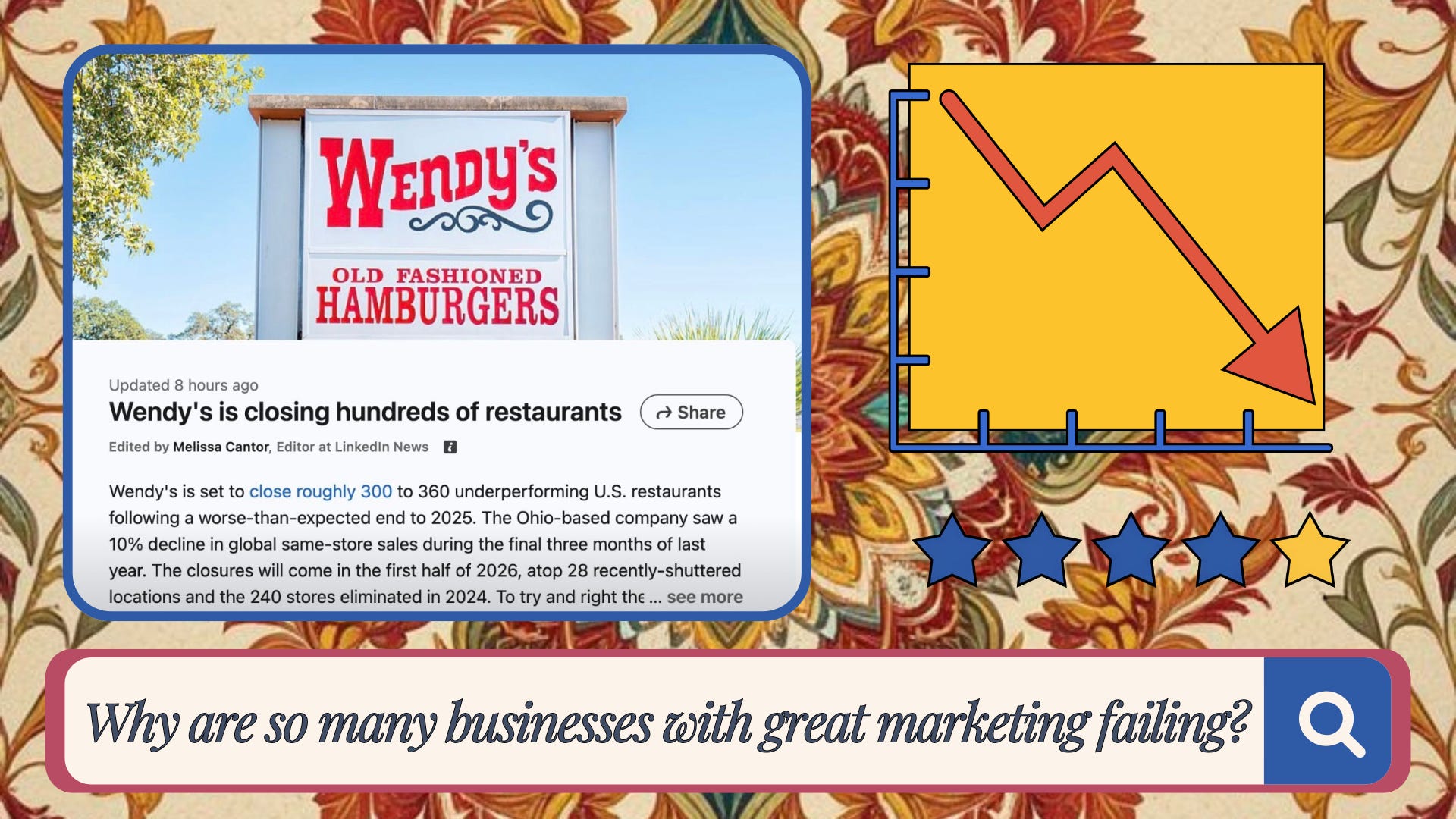
Here’s what companies keep getting wrong. They treat marketing as the business's growth engine. They assume that if revenue stalls, if customers churn, or if stores close, the solution must live in campaigns, brand visibility, or ad performance.
It rarely does.
Marketing is not just the engine. It is the amplifier.
It scales whatever already exists inside the organization. Good or bad. When the foundation is strong, marketing accelerates growth. When the foundation is fractured, marketing exposes the cracks faster than leadership is prepared for.
And I’ve watched this play out repeatedly.
The Reputation Suppression
I’ve sat on marketing teams where we flagged negative reviews internally, not casually, but systematically. We identified patterns. We mapped recurring complaints. We outlined operational breakdowns causing customer dissatisfaction. We presented recommendations to fix the root causes.
Most of the time, the response was not, “Let’s fix the experience.”
It was, “Can we report the review and get it taken down?”
But when conversion rates declined because prospects saw the reputation issues, marketing owned the performance metrics. When customers failed to return because of poor experiences, marketing was expected to re-engage them.
You cannot optimize your way out of a broken experience. Suppressing the symptom does not resolve the system creating it.
The Startup That Couldn’t Explain Itself
At a tech startup I worked with, the solutions were not clearly defined. Marketing had strong execution. We showed up at conferences. We had boots on the ground. We listened to prospects in real time.
The most common question we heard was simple: “What exactly do you do?”
That wasn’t a copy issue. It wasn’t a brand awareness issue.
It was a product clarity issue.
We brought this back to leadership repeatedly. The positioning was too open-ended. The solutions weren’t clearly packaged. The market was being asked to interpret what the company itself had not fully defined.
Eventually, the company laid off half the team. Growth stalled. And years later, they still struggle to articulate their technology in a way that resonates.
No campaign can compensate for structural ambiguity.
When Leadership Is Willing to Look at the Foundation
I’ve also seen the opposite.
Before building a marketing strategy for one agency, I audited the full customer lifecycle. Leadership expectations. Sales processes. Onboarding workflows. Account management structure. Feedback from long-term clients.
The goal wasn’t to critique. It was to identify friction before scaling demand.
Because leadership was receptive, we streamlined the sales process, clarified deliverables, tightened onboarding, improved internal communication, and strengthened retention before increasing visibility.
Then we layered marketing on top.
It worked, not just because the campaigns were extraordinary, but because the experience could finally support the growth.
Marketing performs best when it isn’t compensating for operational instability.
The Visibility Misdiagnosis
Even when recognizable brands announce store closures, like Wendy’s recently did, the public conversation immediately turns to marketing. Did the campaigns miss? Did the brand lose relevance? Was there a positioning failure?
Visibility is rarely the root issue.
More often, it’s customer experience issues, operational dysfunction, training inconsistencies, product issues, or systemic misalignment between what’s promised and what’s delivered. All things marketing alone cannot solve.
Marketing can drive attention.
It cannot repair internal dysfunction.
But it will shine a brighter light on it.
Marketing Is Often Asked to Carry What It Didn’t Break
This is why, as a marketing consultant, I integrate operational analysis into every marketing engagement I take on with my clients.
Because if you want improved marketing performance, we need systems that can sustain growth. If you want higher conversion, we need an experience worth returning to. If you want scale, we need clarity, alignment, and execution underneath the brand.
Marketing is often not as broken as leaders assume.
There are always ways to improve, sure.
But more often than not, marketing is frequently just reactive or a band-aid fix, brought in after foundational issues have already compounded, and then it’s expected to solve them through messaging alone.
That expectation is where companies keep getting it wrong.
Marketing doesn’t fix operational problems.
It reveals them.
And only the organizations willing to confront what it reveals will actually grow.
P.👏 S.👏 As I mentioned, this is why I integrate operations into all my marketing engagements. Because if you’re going to improve your marketing, we need to make sure you have the systems to sustain the growth. If you’re going to convert customers, let’s make sure you can actually keep them: Email me at cathannco@gmail.com
Thank you...highly applicable across the board. Marketing is everyone's favorite whipping post. Since I come from the B2B side where sales cycles stretch into hundreds of days, you also must determine whether the product legitimately solves a client problem, as well as integrates well into their other solutuins. No problem, or your product doesn't play well in their sandbox, or for other reason they are not a prospect, no sale. Move on. Youd be surprised how many companies persist on slamming into brick walls..
say it louder 👏👏👏